Free Shipping
Fast Delivery
Safe Payment
30-Day Guarantee
Free Shipping
Fast Delivery
Safe Payment
30-Day Guarantee

Lower Back Stretches for Office Workers

Your back is stiff, tight, and angry. And you've got three more hours at your desk before you can go home. Sound...
Lower Back Stretches for Office Workers - lumbar support and back pain relief

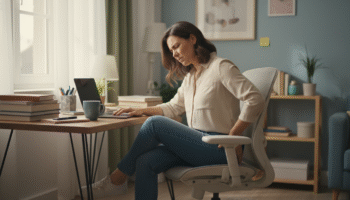
Your back is stiff, tight, and angry. And you’ve got three more hours at your desk before you can go home. Sound familiar?

lower back stretches office – Lower Back Stretches for Office Workers

Office workers face a unique challenge: the need for regular stretching in an environment that makes stretching awkward. You can’t exactly drop into a downward dog during a Zoom call.

This guide gives you 15+ stretches specifically designed for the office—organized by what you can do seated, what requires standing, and what you can do during a real break with floor space. Plus, time-based routines you can actually fit into your workday.

Why Office Workers Need to Stretch

What Sitting Does to Your Muscles

Prolonged sitting creates a predictable pattern of muscle problems:

  • Hip flexors shorten: Constantly held in flexed position
  • Glutes deactivate: Not used while sitting
  • Hamstrings tighten: Held in shortened position
  • Back extensors fatigue: Working to hold you upright
  • Chest muscles tighten: From forward shoulder position

This combination creates the “desk worker posture“—rounded shoulders, forward head, flat back, tight hips. And it leads directly to lower back pain.

The Case for Office Stretching

  • Breaks the static positioning that causes muscle imbalances
  • Improves blood flow to muscles and spinal structures
  • Reduces stiffness and accumulated tension
  • Helps maintain mobility that sitting tries to steal
  • Provides mental breaks that improve focus and productivity

The Stretching Reality

Stretching alone won’t fix sitting-related back pain—you also need proper lumbar support and regular movement. But stretching is an essential component that makes everything else work better.

Seated Stretches (Do These at Your Desk)

1. Seated Cat-Cow

What it stretches: Entire spine, promotes spinal mobility

  1. Sit at front edge of chair, feet flat
  2. Hands on thighs or desk edge
  3. Inhale: Arch back, look up slightly (cow)
  4. Exhale: Round back, tuck chin (cat)
  5. Flow between positions for 10 cycles

When: Every hour or when stiffness begins

2. Seated Spinal Twist

What it stretches: Lower back rotators, obliques

  1. Sit tall with feet flat
  2. Place right hand on outside of left knee
  3. Left hand on armrest or behind you
  4. Gently rotate torso to the left
  5. Hold 20-30 seconds
  6. Repeat other side

When: Every 1-2 hours, especially after focused work

3. Seated Figure-4 (Piriformis Stretch)

What it stretches: Piriformis, hip external rotators, lower back

  1. Sit at front of chair
  2. Cross right ankle over left knee
  3. Keep back straight, lean forward from hips
  4. Feel stretch in right buttock
  5. Hold 30 seconds
  6. Repeat other side

When: Every 1-2 hours, especially if buttock or hip tightness

4. Seated Forward Fold

What it stretches: Lower back extensors, hamstrings

  1. Sit at front of chair, feet wider than hips
  2. Slowly fold forward between your knees
  3. Let arms hang toward floor
  4. Relax head and neck
  5. Hold 30 seconds

When: During breaks, when lower back feels compressed

5. Seated Knee-to-Chest

What it stretches: Lower back, hip

  1. Sit tall in chair
  2. Grasp right knee with both hands
  3. Pull knee toward chest
  4. Hold 20-30 seconds
  5. Repeat other side

When: Every hour, alternating sides

6. Seated Side Stretch

What it stretches: Quadratus lumborum, obliques, lats

  1. Sit tall, feet flat
  2. Raise right arm overhead
  3. Lean torso to the left
  4. Feel stretch along right side
  5. Hold 20 seconds
  6. Repeat other side

When: Every 1-2 hours, especially after leaning to one side

Stretching + Support = Real Relief

Stretching helps, but proper lumbar support prevents the tightness from building up in the first place. Use both for best results.

Add Lumbar Support →

30-Day Money Back
2-Year Warranty
Free Returns
24/7 Support

Prevents Tightness | 30-Day Trial | 2-Year Warranty

Standing Stretches (Requires Getting Up)

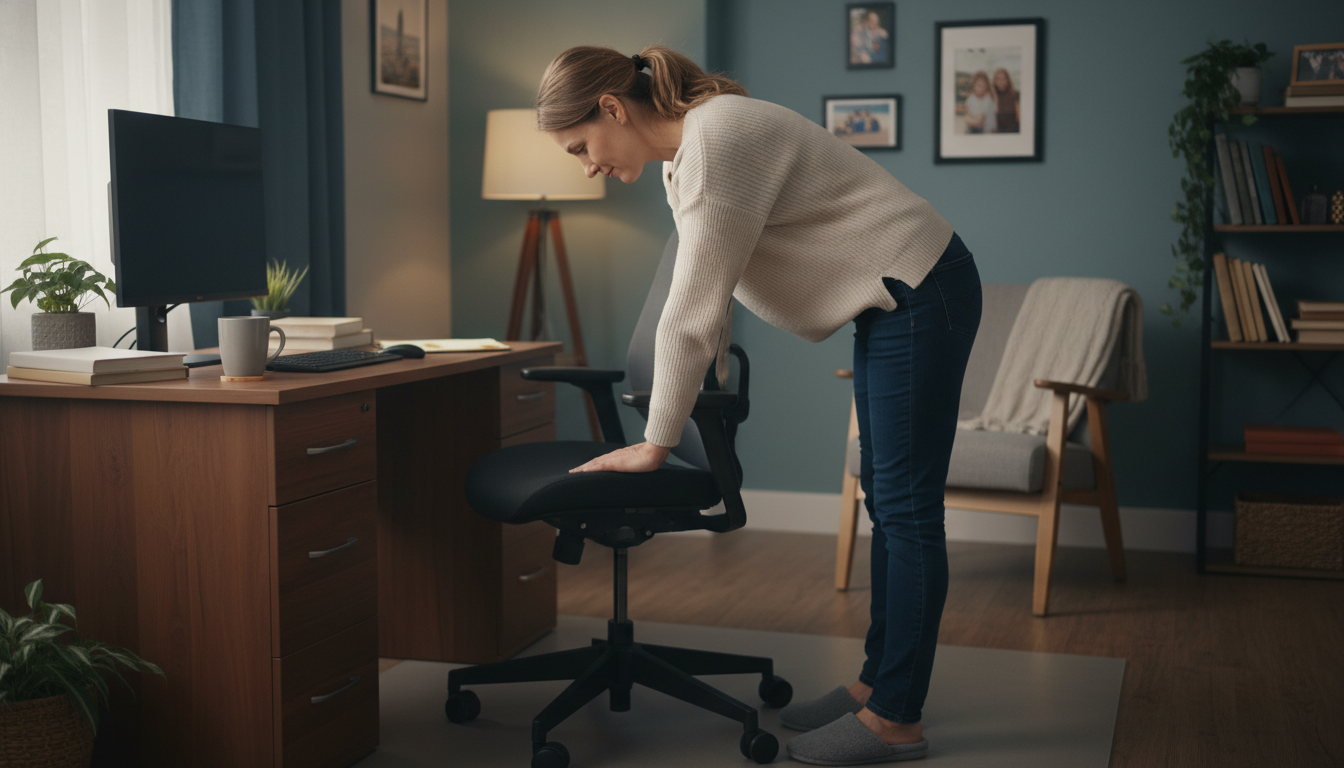
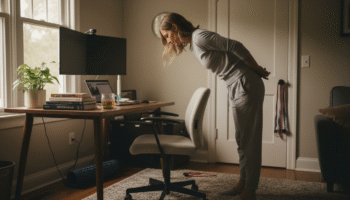
7. Standing Extension

What it stretches: Reverses flexion, decompresses discs

  1. Stand with feet hip-width apart
  2. Place hands on lower back
  3. Gently lean backward
  4. Hold 2-3 seconds
  5. Return to neutral
  6. Repeat 10 times

When: Every 30-60 minutes—most important stretch for sitters

8. Standing Hip Flexor Stretch

What it stretches: Hip flexors (psoas, iliacus)

  1. Stand with right foot forward, left foot back (split stance)
  2. Tuck pelvis under (posterior tilt)
  3. Shift weight slightly forward
  4. Feel stretch in front of left hip
  5. Hold 30 seconds
  6. Repeat other side

When: Every 2 hours—critical for desk workers

9. Standing Quad Stretch

What it stretches: Quadriceps, hip flexors

  1. Stand near desk or wall for balance
  2. Bend right knee, grasp right ankle
  3. Pull heel toward buttock
  4. Keep knees together
  5. Hold 30 seconds
  6. Repeat other side

When: Every 2-3 hours

10. Standing Hamstring Stretch

What it stretches: Hamstrings

  1. Place right heel on low surface (chair, step)
  2. Keep leg straight, foot flexed
  3. Hinge forward from hips (not rounding back)
  4. Feel stretch in back of thigh
  5. Hold 30 seconds
  6. Repeat other side

When: Every 2-3 hours

11. Wall-Assisted Chest Stretch

What it stretches: Chest, anterior shoulders

  1. Stand in doorway or corner
  2. Place forearm on wall, elbow at shoulder height
  3. Step through with same-side leg
  4. Feel stretch across chest
  5. Hold 30 seconds
  6. Repeat other side

When: Multiple times daily—counters forward shoulder posture
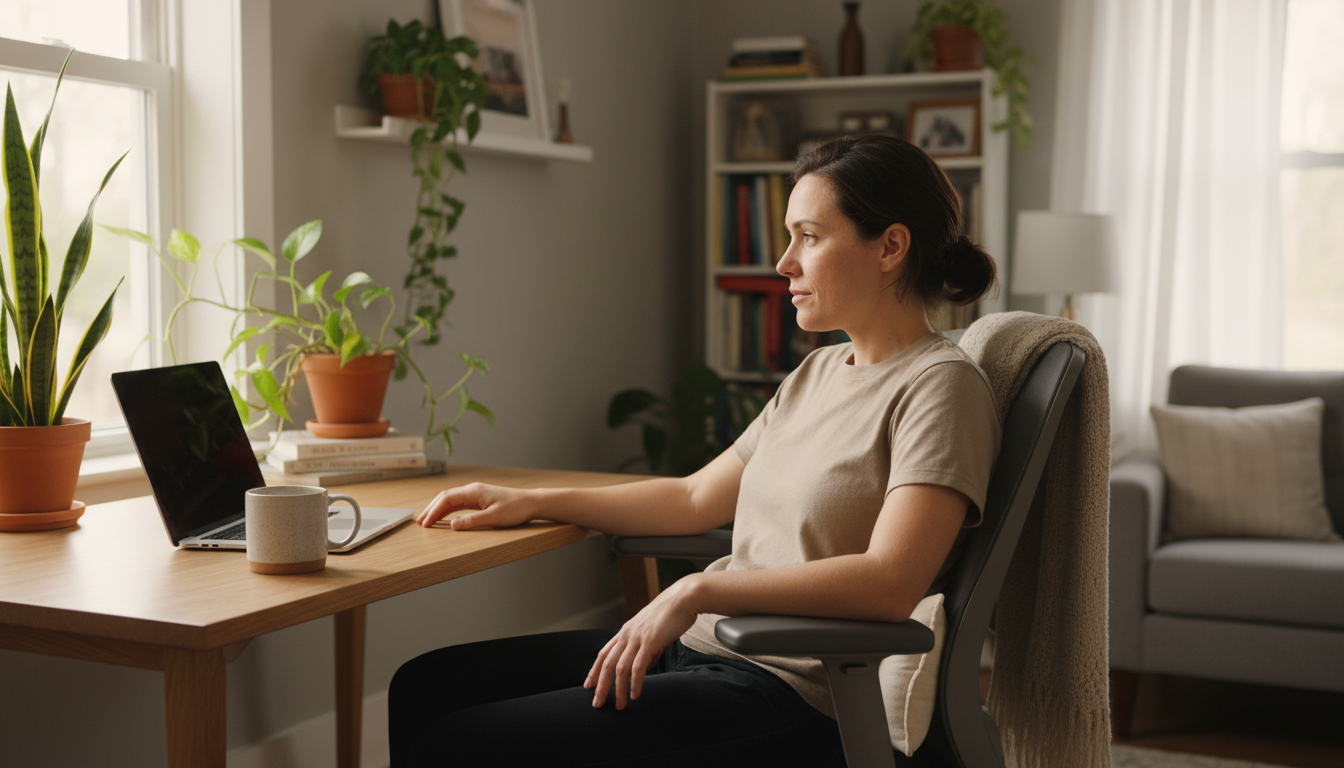
Person using lumbar support pillow in office chair

Floor Stretches (For Real Breaks)

12. Child’s Pose

What it stretches: Lower back, lats, hips

  1. Kneel on floor
  2. Sit back on heels
  3. Fold forward, arms extended
  4. Rest forehead on floor
  5. Hold 1-2 minutes

When: During lunch break or end of day

13. Supine Spinal Twist

What it stretches: Lower back rotators, glutes

  1. Lie on back, knees bent
  2. Drop both knees to the right
  3. Extend arms, look left
  4. Hold 30-60 seconds
  5. Repeat other side

When: During breaks, at home

14. Supine Figure-4

What it stretches: Piriformis, hip rotators

  1. Lie on back, knees bent
  2. Cross right ankle over left knee
  3. Grasp behind left thigh
  4. Pull thigh toward chest
  5. Hold 30-60 seconds
  6. Repeat other side

When: During breaks, before/after work

15. Cat-Cow (Floor Version)

What it stretches: Entire spine

  1. Position on hands and knees
  2. Inhale: Drop belly, lift head (cow)
  3. Exhale: Round back, tuck chin (cat)
  4. Flow for 10-15 cycles

When: During breaks, before/after work

Time-Based Routines

5-Minute Desk Reset

Do every 2-3 hours while seated

  1. Seated Cat-Cow: 5 cycles
  2. Seated Spinal Twist: 20 seconds each side
  3. Seated Side Stretch: 20 seconds each side
  4. Seated Figure-4: 30 seconds each side

10-Minute Standing Break

Do at lunch or mid-afternoon

  1. Walk for 2 minutes
  2. Standing Extensions: 10 reps
  3. Standing Hip Flexor Stretch: 30 seconds each side
  4. Standing Hamstring Stretch: 30 seconds each side
  5. Wall Chest Stretch: 30 seconds each side
  6. Standing Quad Stretch: 30 seconds each side

15-Minute Lunch Break Routine

If you have floor space

  1. Walk for 3 minutes
  2. Standing Extensions: 10 reps
  3. Standing Hip Flexor Stretch: 30 seconds each side
  4. Child’s Pose: 1 minute
  5. Cat-Cow (floor): 10 cycles
  6. Supine Figure-4: 30 seconds each side
  7. Supine Spinal Twist: 30 seconds each side

Frequently Asked Questions

How often should office workers stretch?

At minimum: a few stretches every 1-2 hours. Ideally: micro-stretches every 30 minutes and a longer routine during lunch. The standing extension (hands on lower back, lean back) is the single most important stretch and should be done every 30-60 minutes.

Can stretching at my desk really help back pain?

Yes, but with limitations. Desk stretches help break static positioning, reduce muscle tension, and maintain mobility. However, they work best combined with proper lumbar support, regular standing breaks, and strengthening exercises. Stretching alone won’t fix poor sitting posture.

What is the best stretch for lower back pain from sitting?

The standing extension (hands on lower back, gentle lean backward) is most effective for reversing sitting-induced lumbar flexion. For muscle tightness, the hip flexor stretch is critical. For overall mobility, the cat-cow sequence works well. The best approach is a combination.

Should I stretch even if I’m not in pain?

Yes. Prevention is easier than treatment. Regular stretching maintains mobility and prevents the muscle imbalances that lead to pain. If you wait until you’re in pain, you’re already behind.

Is it bad to crack my back while stretching?

Occasional, gentle self-cracking during stretches is generally harmless. The sound is usually gas being released from joint capsules. However, don’t force cracks, don’t do it repeatedly, and if it causes pain or doesn’t provide relief, stop. Chronic self-manipulation may indicate joint instability.

The Bottom Line

Office stretching is essential—but it’s not complicated. The keys:

  1. Frequency beats duration: Short, frequent stretches trump occasional long sessions
  2. Standing extension is #1: Do it every 30-60 minutes
  3. Hip flexors need attention: They shorten constantly while sitting
  4. Seated stretches maintain function: Better than nothing when you can’t get up
  5. Combine with support: Stretching works best with proper lumbar support

Build stretching into your day as a non-negotiable habit. Your back will thank you.

Stretch Better, Sit Better

Combine regular stretching with proper lumbar support for the best results. Our AirFlex™ pillow maintains your spinal curve between stretch breaks.

Complete Your Ergonomic Setup →

30-Day Money Back
2-Year Warranty
Free Returns
24/7 Support

30-Day Money-Back Guarantee | 2-Year Warranty | Free Shipping

More Posts

Your Cart

Your cart is empty

Looks like you haven't added anything yet.

Start Shopping