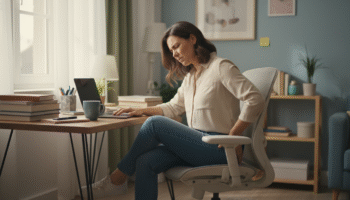
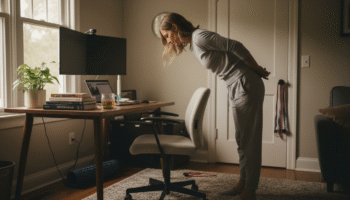
Your glutes have forgotten how to work. It sounds strange, but after years of sitting for 8+ hours a day, the largest, most powerful muscles in your body can...
Your glutes have forgotten how to work. It sounds strange, but after years of sitting for 8+ hours a day, the largest, most powerful muscles in your body can become so underactive that they essentially stop firing when you need them. And when your glutes check out, your lower back has to pick up the slack.
gluteal amnesia back pain – Gluteal Amnesia and Back Pain
Gluteal amnesia—also called “dead butt syndrome”—isn’t just a catchy name. It’s a real neuromuscular problem that affects millions of desk workers and is a leading contributor to chronic lower back pain.
This guide explains what gluteal amnesia is, how it causes back pain, and the activation exercises that can wake up your glutes and protect your spine.
Understanding Gluteal Amnesia
What Is Gluteal Amnesia?
Gluteal amnesia is a condition where the gluteal muscles become inhibited and fail to activate properly during movement:
The glutes don’t fire when they should
Neural pathways to the glutes become weak
Other muscles compensate for glute weakness
The brain “forgets” how to use the glutes efficiently
The Three Gluteal Muscles
Gluteus maximus: The largest muscle—extends and externally rotates the hip
Gluteus medius: Side of hip—stabilizes pelvis, hip abduction
Gluteus minimus: Deep to medius—assists with stabilization and abduction
Why “Amnesia”?
The term reflects what happens neurologically:
Prolonged sitting keeps glutes in a stretched, inactive position
Neural drive to the glutes decreases from disuse
The motor cortex reduces activation signals over time
The brain literally “forgets” to activate these muscles
Even when you try to use them, the signal is weak
The Reciprocal Inhibition Factor
When hip flexors are tight and overactive (common from sitting), they neurologically inhibit the glutes. It’s called reciprocal inhibition—when one muscle group is tight, the opposite group becomes weak. This is why hip flexor stretching and glute activation should go together.
How Gluteal Amnesia Causes Back Pain
The Compensation Chain
When glutes don’t work properly, other muscles must compensate:
Glute Function
Compensating Muscle
Resulting Problem
Hip extension
Hamstrings, low back extensors
Hamstring strains, back pain
Pelvic stability
Lumbar spine muscles
Chronic back muscle fatigue
Hip rotation
Piriformis, TFL
Piriformis syndrome, IT band issues
Single-leg stability
Quadratus lumborum
One-sided back pain
The Sitting-Glute-Back Connection
Prolonged sitting compresses and deactivates glutes
Hip flexors tighten and inhibit glute activation
Neural pathways to glutes weaken from disuse
When standing/walking, glutes don’t fire properly
Back muscles must do the glutes’ job
Back muscles fatigue and become painful
Pain leads to more sitting, cycle worsens
Impact on Walking and Standing
With gluteal amnesia:
Walking: Each step should be powered by glutes—instead, back extensors work overtime
Standing: Glutes should help stabilize pelvis—instead, back muscles grip constantly
Climbing stairs: Glutes should drive the movement—instead, quads and back compensate
Lifting: Hip hinge should use glutes—instead, lower back takes the load
Do You Have Gluteal Amnesia?
Self-Assessment Tests
Test 1: Single-Leg Glute Bridge
Lie on back, knees bent
Lift one foot off ground
Try to bridge up using the planted leg
Signs of trouble: Hamstring cramps, can’t hold position, pelvis drops on the lifted side
Test 2: Prone Hip Extension
Lie face down
Keeping leg straight, lift one leg off ground
Have someone (or yourself) feel which muscle fires first
Normal: Glute fires first, then hamstring
Gluteal amnesia: Hamstring or back fires first, glute delayed or absent
Test 3: Standing Glute Squeeze
Stand normally
Try to squeeze one glute hard
Signs of trouble: Can’t isolate, have to squeeze both, feels weak, other muscles compensate
Common Symptoms
Lower back pain worse after sitting, better with rest
Pain when walking, especially longer distances
Feeling that back muscles are always tight
Hamstring tightness or strains
Hip pain or bursitis
Flat buttocks appearance (muscle atrophy)
Difficulty climbing stairs without back pain
Support Your Spine While You Wake Up Your Glutes
Our lumbar pillow reduces back muscle strain while you work on rebuilding glute strength—giving your back relief during the recovery process.
Don’t skip days—neural pathways need reinforcement
Maintain exercises even after pain resolves
Frequently Asked Questions
Can gluteal amnesia cause lower back pain?
Yes, it’s one of the leading causes of desk-job back pain. When your glutes don’t fire properly, your lower back muscles must compensate for functions the glutes should perform—like hip extension during walking and pelvic stability during movement. This overworks your back muscles, leading to fatigue, tension, and pain.
How do I know if my glutes are weak or just not activating?
Often it’s both—they’re weak because they haven’t been activating. The key sign is compensation: if your hamstrings cramp during bridges, your back arches during leg lifts, or you can’t isolate a glute squeeze, you have activation problems. Pure weakness shows as inability to complete movements even with good form.
Will squats fix gluteal amnesia?
Not necessarily. If you can’t activate your glutes, you’ll do squats using mostly your quads and back, reinforcing the compensation pattern. You need to first learn to activate and isolate the glutes before adding compound movements. Once activation is established, squats can be excellent for glute strengthening.
How often should I do glute activation exercises?
Daily, especially in the early phases. Think of it like rehabilitation—you’re rewiring neural pathways that have been dormant. Five to ten minutes daily is better than 30 minutes twice a week. Once glutes are activating well, you can reduce to 3-4 times per week for maintenance.
Does sitting on a hard surface help prevent gluteal amnesia?
Not significantly. The main problem is the prolonged hip flexion and compression, not the surface hardness. What helps more is regular standing breaks, glute squeezes while sitting, and proper lumbar support to maintain pelvic position. Hard surfaces may actually increase discomfort without addressing the underlying issue.
The Bottom Line
Gluteal amnesia is a reversible condition, but it takes intentional work:
Understand the problem: Your brain has forgotten how to use your strongest muscles
Test yourself: Use the self-assessment to confirm glute activation issues
Start with isolation: Learn to feel and fire glutes before adding movement
Progress systematically: Build from isolation to functional integration
Be consistent: Daily practice rewires neural pathways
Address the cause: Break up sitting, stretch hip flexors, support your spine
Waking up your glutes can transform your relationship with back pain.
Protect Your Back While You Rebuild
Our ergonomic lumbar pillow supports your spine while you work on glute activation—giving your back muscles the relief they need during recovery.