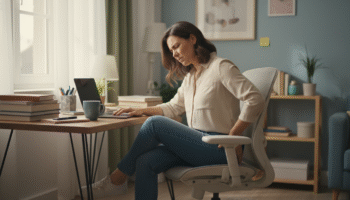
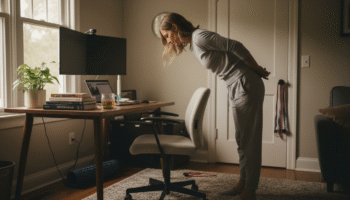
Your couch is comfortable for a reason—and it's ruining your back. Couches are designed to make you sink in and relax, which feels great in the moment but...
Your couch is comfortable for a reason—and it’s ruining your back. Couches are designed to make you sink in and relax, which feels great in the moment but promotes exactly the posture your spine hates most. That’s why you can sit on the couch for hours feeling fine, then struggle to stand up straight afterward.
We’re not going to tell you to never sit on your couch. That’s unrealistic. But understanding why couches cause back pain—and how to minimize the damage—can help you enjoy relaxation time without paying for it later.
This guide covers the couch-back pain connection and practical strategies for more comfortable lounging.
Why Couches Are Terrible for Your Back
The Design Problem
Couches are designed for comfort, not support:
Soft cushions: Let you sink in, eliminating spinal support
Low seat height: Forces deep hip flexion
Backward-sloping seat: Tilts pelvis backward, flattens lumbar curve
Deep seat: Too long for most people’s thighs
No lumbar support: Zero support where you need it most
What Happens When You Sink In
You sit down and sink into soft cushions
Hips drop below knees (deep hip flexion)
Pelvis tilts backward
Lumbar curve reverses (flexion instead of extension)
Spine forms a C-shape instead of natural S-curve
Disc pressure increases 40-90%
Muscles and ligaments stretch and strain
The “Relaxation” Trap
Why it feels comfortable initially:
Soft surface reduces pressure points
No effort required—you let muscles go slack
Immediate sensation of relaxation
Pain often delayed—appears later or next morning
What’s actually happening:
Passive structures (discs, ligaments) take all the load
Spinal structures are stressed beyond normal range
Accumulating strain that shows up later
The Next-Morning Effect
Ever feel fine after a Netflix marathon but wake up with a stiff, painful back? That’s the delayed effect of couch sitting. Spinal structures that were stressed for hours don’t complain until you try to move normally—often revealing the damage the next morning.
Making Couch Sitting Less Damaging
The Essential: Lumbar Support
Add support behind your lower back:
Purpose-built lumbar pillow: Best option—designed for the job
Perfect for Lounging | 30-Day Trial | 2-Year Warranty
Alternative Couch Positions
Position 1: Supported Upright
Best for back health:
Sit toward front of cushion
Lumbar support in place
Feet flat on floor
Back doesn’t touch couch backrest (uses lumbar pillow instead)
Position 2: Reclined with Support
For longer relaxation:
Recline into couch
Firm pillow behind lumbar
Pillow under knees
Better than unsupported but not ideal for hours
Position 3: Side-Lying
Changes the equation entirely:
Lie on side with knees slightly bent
Pillow under head
Pillow between knees for hip alignment
Can watch TV comfortably in this position
Much better for your spine than sitting slumped
Position 4: Floor Sitting
Alternative to the couch:
Sit on floor with back against couch (couch as backrest)
Lumbar support between you and couch
Legs extended or crossed
More space to change positions
Activities and Couch Posture
Watching TV
Position screen at comfortable viewing angle (don’t twist)
Use lumbar support
Get up during commercial breaks or between episodes
Consider lying down for long movie watching
Reading
Don’t hunch over a book—bring the book up
Use a reading pillow or lap desk
Position for neck-neutral reading angle
Change positions every 20-30 minutes
Phone/Tablet Use
Don’t look down at your lap
Prop device up at eye level
Support elbows to reduce shoulder strain
Worst position: hunched over phone on soft couch
Working from the Couch
Try to avoid this, but if you must:
Limit to 30 minutes maximum
Use lap desk to bring keyboard/laptop up
Maximum lumbar support
This is emergency-only, not a regular practice
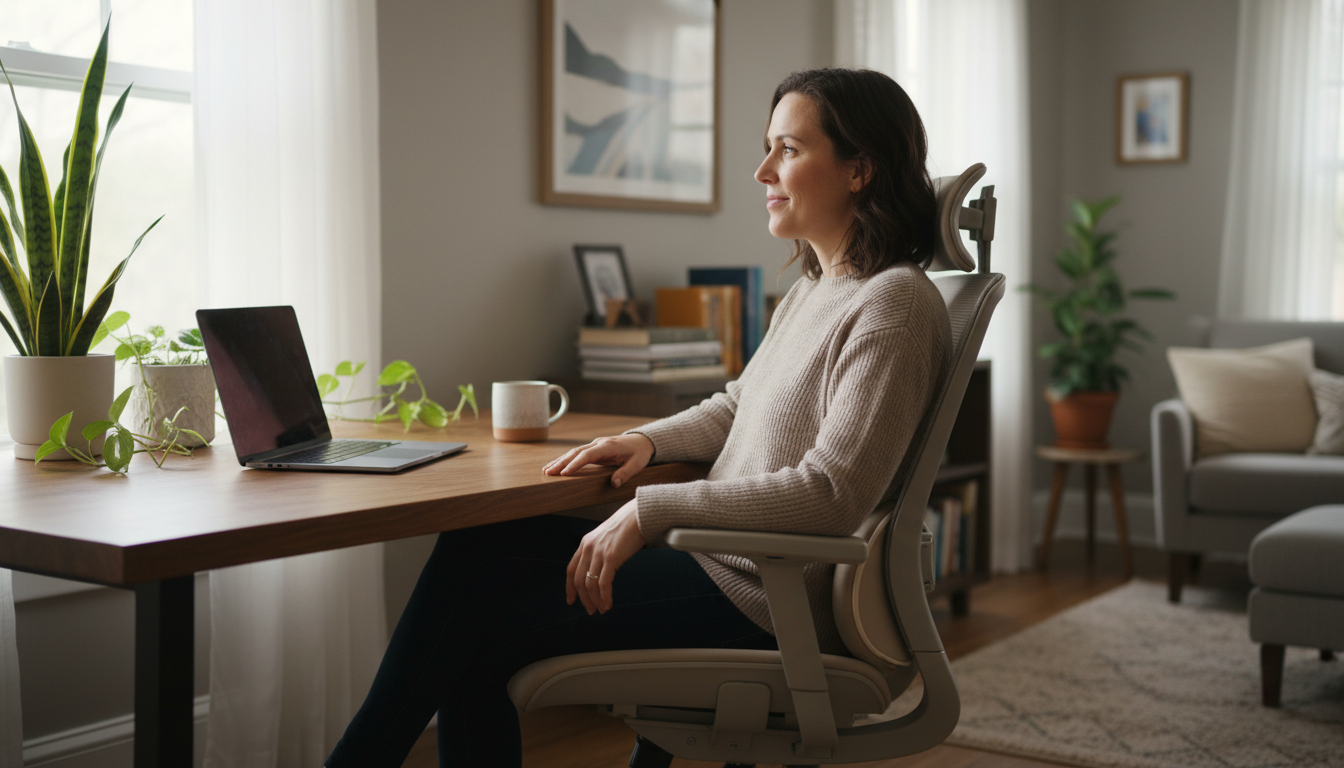
Person using lumbar support pillow in office chair
Choosing a Back-Friendly Couch
Features to Look For
Firmer cushions: Provide more support, less sinking
Higher seat height: Reduces deep hip flexion
Shallower seat depth: Allows back contact with backrest
Structured support: Not just soft filling throughout
Features to Avoid
Very soft cushions: You sink to the frame
Low-profile design: Forces deep hip flexion
Extra-deep seats: Can’t reach the backrest
Backward-sloping seats: Forces pelvis tilt
The Recliners Debate
Recliners can be better or worse:
Better if:
Has built-in lumbar support
Elevates legs (reduces lumbar stress)
Quality construction with good support
Worse if:
Cheap construction, poor support
Forces awkward positions
No lumbar support in any position
Recovery After Couch Time
Immediate Stretches
Standing back extension:
Stand up, hands on lower back
Gently arch backward
Hold 5 seconds, repeat 10 times
Reverses the flexion from couch sitting
Hip flexor stretch:
Step one foot forward into lunge
Keep back straight
Feel stretch in front of back hip
30 seconds each side
Cat-cow stretches:
On hands and knees
Arch back up (cat), then down (cow)
10 slow repetitions
Walking It Off
5-10 minute walk after long couch sessions
Restores normal spinal mechanics
Increases blood flow to muscles
Helps prevent next-morning stiffness
Frequently Asked Questions
Why does my back hurt after sitting on the couch but not in my office chair?
Office chairs (even mediocre ones) maintain some lumbar support and proper seat height. Couches are designed for relaxation, not support—soft cushions let your spine slump into flexion, which stresses discs and ligaments. The “comfort” of sinking into a couch is actually your spine losing its natural curve.
Can I make my existing couch more back-friendly?
Yes. Add a firm lumbar support pillow, avoid sinking into the deepest part of the cushions, and limit time in any one position. You can also add firm cushions on top of soft ones to reduce sinking. But the fundamental problem—soft, deep, low seating—can only be partially addressed.
Is lying on the couch better than sitting on it?
Often yes. Side-lying with a pillow between your knees maintains better spinal alignment than slumped sitting. Lying on your back with knees supported is also better than sitting slumped. The key is supporting your natural spinal curves rather than letting them flatten or reverse.
How long can I sit on the couch without hurting my back?
This varies by individual and couch, but general guidelines: change position every 30 minutes, get up and move every 60 minutes, and limit total couch time with poor support. With proper lumbar support and good positioning, you can extend these times. Without support, damage accumulates faster than you feel it.
Should I stop sitting on my couch entirely?
That’s unrealistic for most people. Instead, minimize damage: use lumbar support, vary positions, take movement breaks, and stretch afterward. Reserve the couch for relaxation and use proper seating for work or extended activities. Being thoughtful about couch time is more sustainable than avoiding it completely.
The Bottom Line
Couches will always be imperfect for your back, but you can minimize the damage:
Add lumbar support: The single most important intervention
Mind your position: Avoid the deepest slump
Set time limits: Change position every 30 minutes
Try lying down: Often better than sitting for long periods
Stretch after: Reverse the flexion before bed
Your couch isn’t the enemy—but it needs help to be a friend to your back.
Enjoy Your Couch Again
Our lumbar pillow adds the support your couch is missing—making relaxation time actually relaxing for your back.