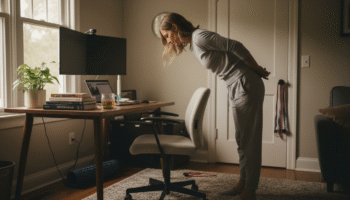
Your core doesn't stop working just because you're sitting—but sitting all day can make it forget how to work properly. The muscles that should support your...
Your core doesn’t stop working just because you’re sitting—but sitting all day can make it forget how to work properly. The muscles that should support your spine during eight hours at a desk often become weak, inhibited, or simply disengaged. The result? Your back takes over, and pain follows.
core exercises desk job – Core Exercises for Sitting All Day
Building core strength isn’t about six-pack abs or doing hundreds of crunches. For desk workers, it’s about training the muscles that stabilize your spine to stay active during prolonged sitting—and having the endurance to maintain good posture all day.
This guide covers core exercises specifically designed for people who sit at desks, organized by what you can do where and when.
Why Core Strength Matters for Desk Workers
The Core’s Real Job
Your “core” isn’t just your abs—it’s a cylinder of muscles surrounding your spine:
Transverse abdominis: Deep corset muscle that wraps around your midsection
Multifidus: Small muscles along your spine providing segmental stability
Diaphragm: Breathing muscle that forms the top of the core cylinder
Pelvic floor: Forms the bottom of the core cylinder
Rectus abdominis: The “six-pack” muscles (less important for sitting)
Obliques: Side muscles for rotation and lateral stability
What Happens When You Sit All Day
Reduced activation: Core muscles become less active when not needed
Positional weakness: Slumped posture inhibits deep stabilizers
Endurance loss: Even strong muscles fatigue without training
Imbalance development: Some muscles overwork while others underwork
Motor pattern disruption: Your brain “forgets” to engage stabilizers
The Posture Connection
Core strength alone doesn’t fix sitting posture. You need:
Endurance: Ability to maintain activation for hours, not seconds
Motor control: Brain-muscle connection to engage core automatically
External support: Lumbar support reduces the demand on fatiguing muscles
Core Strength vs. Core Endurance
Being able to plank for two minutes doesn’t mean your core can support good posture for eight hours. Desk work requires endurance (low-level sustained activation) more than strength (high-effort short bursts). Your training should reflect this—longer holds, more repetitions, lower intensity.
At-Desk Core Exercises
These exercises can be done seated at your desk without anyone noticing:
1. Seated Abdominal Bracing
The foundation exercise for desk workers:
Sit tall with feet flat on floor
Gently draw navel toward spine (don’t hold breath)
Imagine tightening a belt around your midsection
Hold for 10 seconds while breathing normally
Relax completely, then repeat
Do: 10 repetitions every hour
Common mistakes: Holding breath, sucking in stomach (different from bracing), clenching too hard
2. Seated Pelvic Tilts
Mobilizes spine and activates deep core:
Sit on front half of chair
Tilt pelvis forward (arch lower back slightly)
Tilt pelvis backward (flatten lower back)
Move slowly, feeling each vertebra
Do: 15 tilts, 3 times per day
3. Seated Marching
Challenges core stability during movement:
Sit tall, brace core gently
Lift one knee 2-3 inches off chair
Hold 5 seconds
Lower slowly, repeat other side
Keep torso completely still—no leaning
Do: 10 each side, twice per day
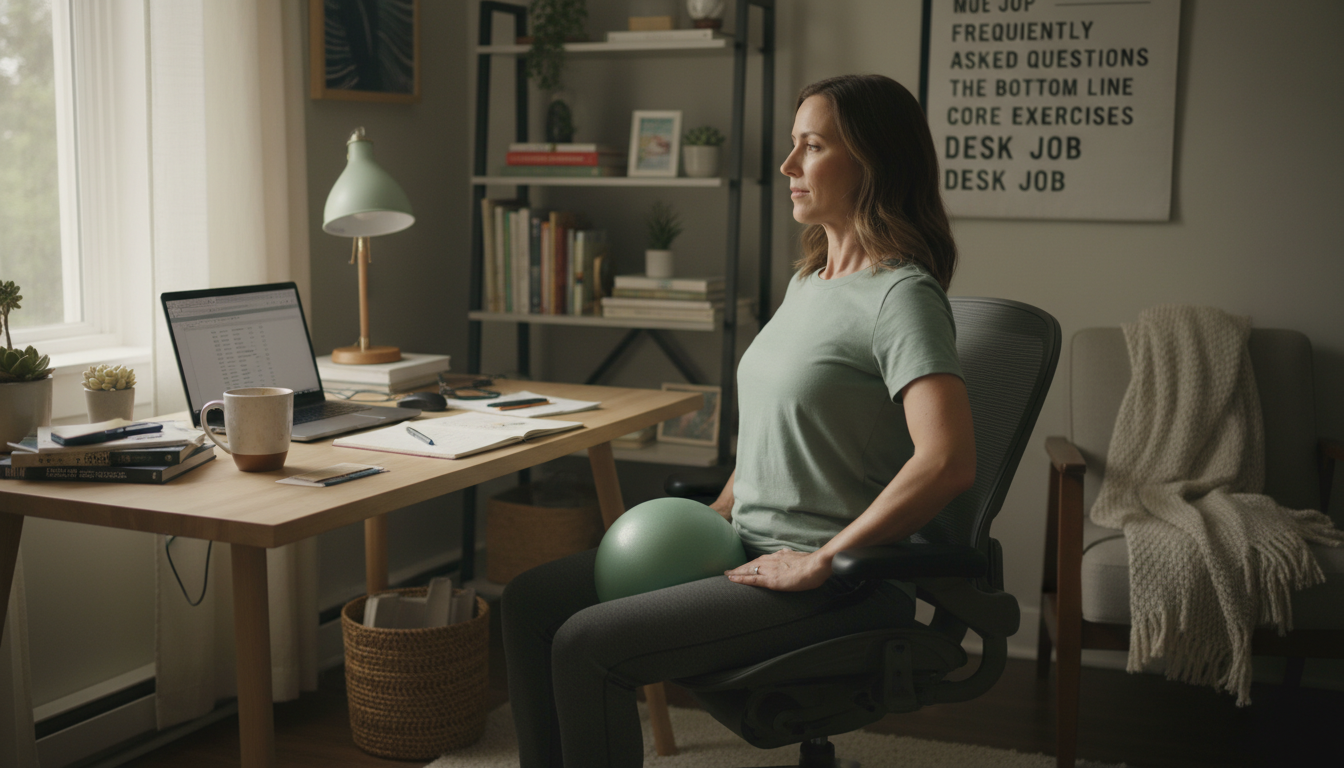
4. Seated Knee Squeeze
Activates inner thighs and pelvic floor:
Place fist or small ball between knees
Squeeze knees together moderately
Hold 10 seconds while breathing
Release slowly
Do: 10 squeezes, 3 times per day
5. Seated Heel Raises
Activates lower limbs and challenges stability:
Sit tall, brace core
Raise heels off floor, keeping balls of feet down
Hold 5 seconds
Lower slowly
Do: 15 repetitions, hourly
Support Your Core While It Gets Stronger
While building core endurance, our lumbar pillow provides external support that reduces fatigue and helps maintain proper positioning.
At desk: Reduce frequency, maintain activation awareness
Breaks: Efficiency focus—best exercises only
Floor: Add intermediate/advanced as appropriate
Common Mistakes to Avoid
Training Mistakes
Too much rectus focus: Crunches don’t help sitting—train deep core
Breath holding: You must breathe while bracing—practice this
Going too hard: Endurance requires sustained low-level activation
Ignoring motor control: Strength without control doesn’t transfer to sitting
Skipping daily practice: Hourly desk exercises matter more than weekly gym sessions
Expectation Mistakes
Expecting quick fixes: Core endurance takes 6-8 weeks to build
Thinking core alone is enough: You still need external support and good posture habits
Stopping when pain improves: Maintenance is required long-term
Frequently Asked Questions
How long until I see results from core exercises?
Motor control improvements (better automatic activation) can start within 2-3 weeks of consistent practice. Strength and endurance gains typically take 6-8 weeks. However, you may notice reduced end-of-day fatigue and discomfort sooner. The key is consistency—daily desk exercises plus 3x weekly floor routines.
Will a strong core fix my sitting posture automatically?
Not automatically. Core strength creates the capacity for good posture, but you still need: awareness to engage it, external support to reduce fatigue, and habit development to maintain it. A strong core that isn’t activated during sitting provides no benefit. That’s why motor control training (at-desk exercises) matters as much as strength training.
I sit for 8+ hours—can exercises really help?
Yes, but exercises alone aren’t enough for extreme sitting durations. Combine core training with: standing breaks every 30-60 minutes, proper lumbar support (external support reduces core demand), walking breaks, and ergonomic setup optimization. Core exercises help your muscles tolerate sitting better—but no muscle can maintain perfect activation for 8 hours without support and rest.
Are planks the best exercise for desk workers?
Planks are good but not necessarily best. For desk workers, exercises that train motor control (like dead bugs and seated bracing) are often more valuable because they teach your brain to activate core muscles automatically. Planks build strength and endurance, but the ability to brace while breathing and moving matters more for sitting tolerance.
Can I do core exercises if I currently have back pain?
Most people can do gentle core activation even with back pain—in fact, proper core training often helps. Start with low-intensity exercises like seated bracing and pelvic tilts. Avoid exercises that increase your pain. If pain is significant or worsening, consult a healthcare provider before starting any exercise program. Many physical therapists prescribe core exercises as treatment for back pain.
The Bottom Line
Building core strength for desk work requires a specific approach:
Train endurance: Long holds and high reps over heavy resistance
Practice daily: Hourly desk exercises matter most
Focus on motor control: Train your brain to engage core automatically
Use external support: Lumbar support reduces demand while you’re building strength
Be patient: 6-8 weeks of consistent work for real results
Your core can become your spine’s best ally during long desk hours—but it needs regular training and appropriate support to do its job.
Core Training + External Support = Best Results
While building core endurance, our lumbar pillow provides the external support that helps maintain good positioning without exhausting your muscles.