

Gluteal Amnesia and Back Pain
Your glutes have forgotten how to work. It sounds strange,

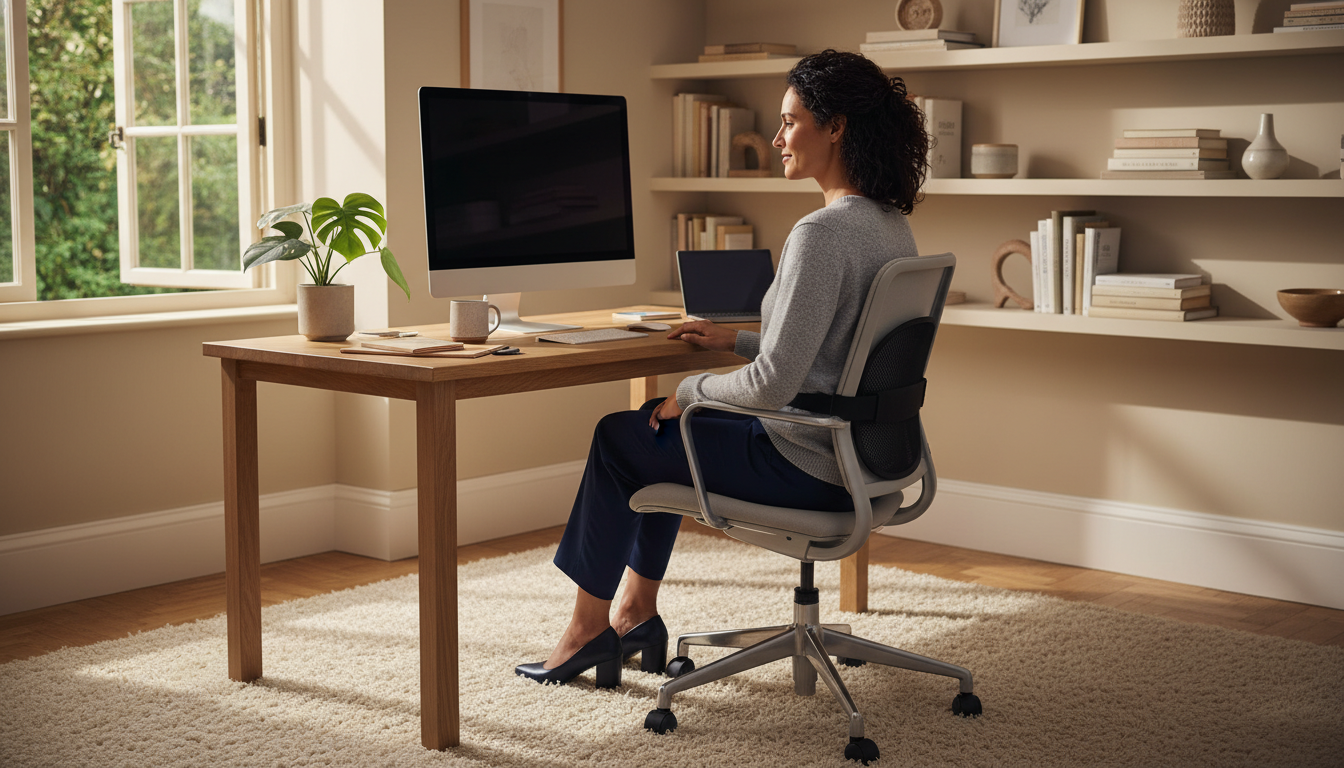
Back pain from sitting isn’t always about your chair’s backrest—often, the problem starts at your seat base. The wrong sitting surface creates pelvic tilt that cascades up your spine, causing lower back pain regardless of how good your lumbar support is. The right seat cushion addresses the foundation of sitting posture.
📋 Table of Contents
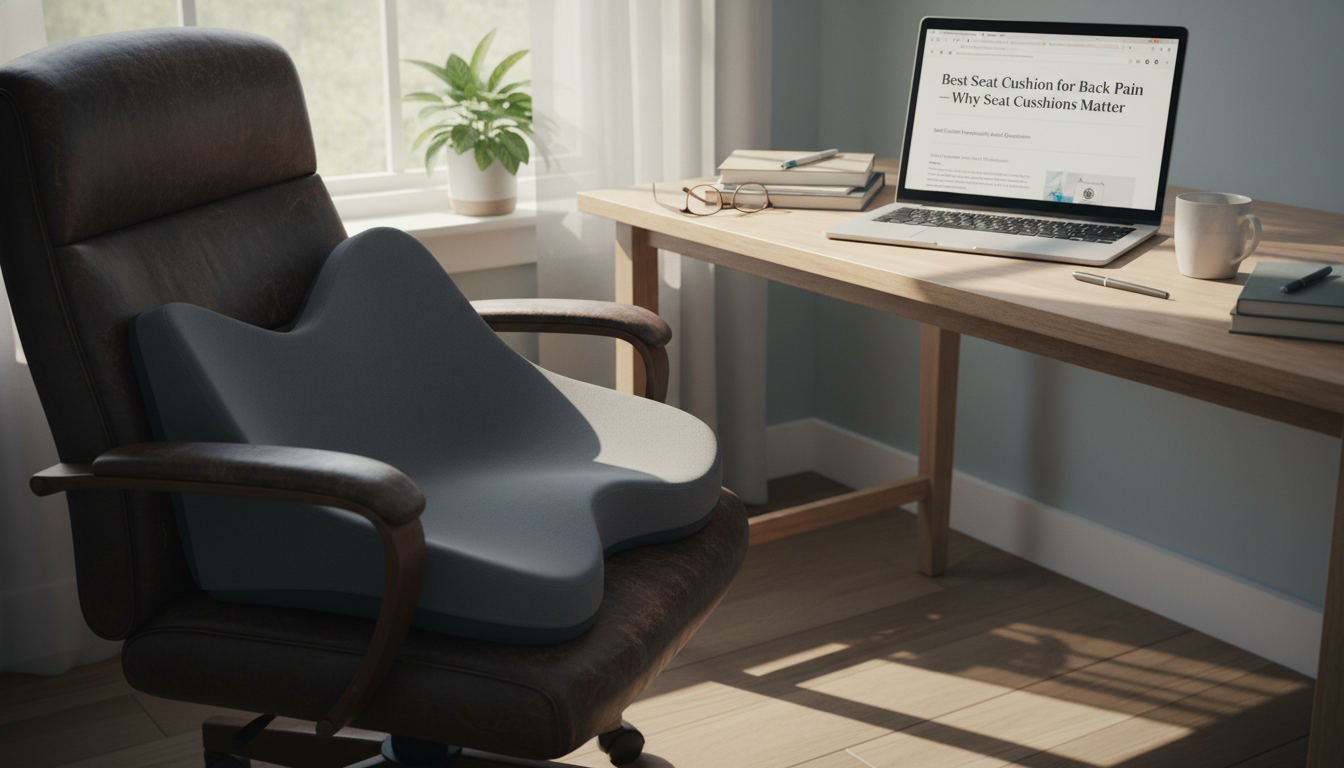
Your pelvis is the foundation of your sitting posture. When you sit on a flat, hard, or poorly designed surface, several problems develop:
Flat surfaces allow your pelvis to rotate backward (posterior pelvic tilt). This flattens your lumbar curve—the exact curve your lower back needs to maintain for pain-free sitting. No amount of lumbar support can fully compensate for a pelvis tilting the wrong direction.
Standard chair seats concentrate pressure on your sit bones (ischial tuberosities) and tailbone. Prolonged pressure causes discomfort that makes you shift position constantly, disrupting good posture and stressing your lower back.
Hard or poorly designed surfaces compress blood vessels and nerves in your thighs and buttocks. This creates numbness, tingling, and the need to constantly shift—all contributing to back strain.
| Type | Best For | Key Features |
|---|---|---|
| Memory Foam Contoured | All-day office use | Conforms to body, promotes neutral pelvis |
| Coccyx Cutout | Tailbone pain, sciatica | U-shaped cutout relieves tailbone pressure |
| Gel-Infused | Hot environments, temperature sensitivity | Cooling properties, pressure distribution |
| Wedge Cushion | Anterior pelvic tilt correction | Tilts pelvis forward, opens hip angle |
| Combination | Multiple issues | Combines contour, cutout, and gel |
Memory foam cushions remain the most popular choice for back pain relief, and for good reason:
Density: 3.5-5 lbs/ft³ for adequate support (lower density bottoms out)
Thickness: 2-3 inches minimum for meaningful cushioning
Contour: Raised edges or thigh channels maintain position
Certification: CertiPUR-US ensures quality and safety standards
If your back pain centers around your tailbone or you have sciatica symptoms, coccyx cushions provide targeted relief:
A cutout at the back of the cushion suspends your tailbone, eliminating direct pressure. This helps with:
Coccyx cushions aren’t necessary for everyone. They’re specifically valuable if you:
Wedge cushions take a different approach—instead of just adding padding, they change your sitting angle:
A wedge tilts your pelvis slightly forward (anterior tilt), which:
Most people do well with an 8-15 degree forward tilt. Steeper angles (15-20 degrees) work for some but may strain hips for others. Start with a moderate angle and adjust based on comfort.
| Factor | Wedge | Contoured |
|---|---|---|
| Primary function | Change sitting angle | Distribute pressure |
| Best for | posture correction | Comfort and support |
| Adjustment period | 1-2 weeks | Immediate |
| Hip flexibility needed | Moderate | None |
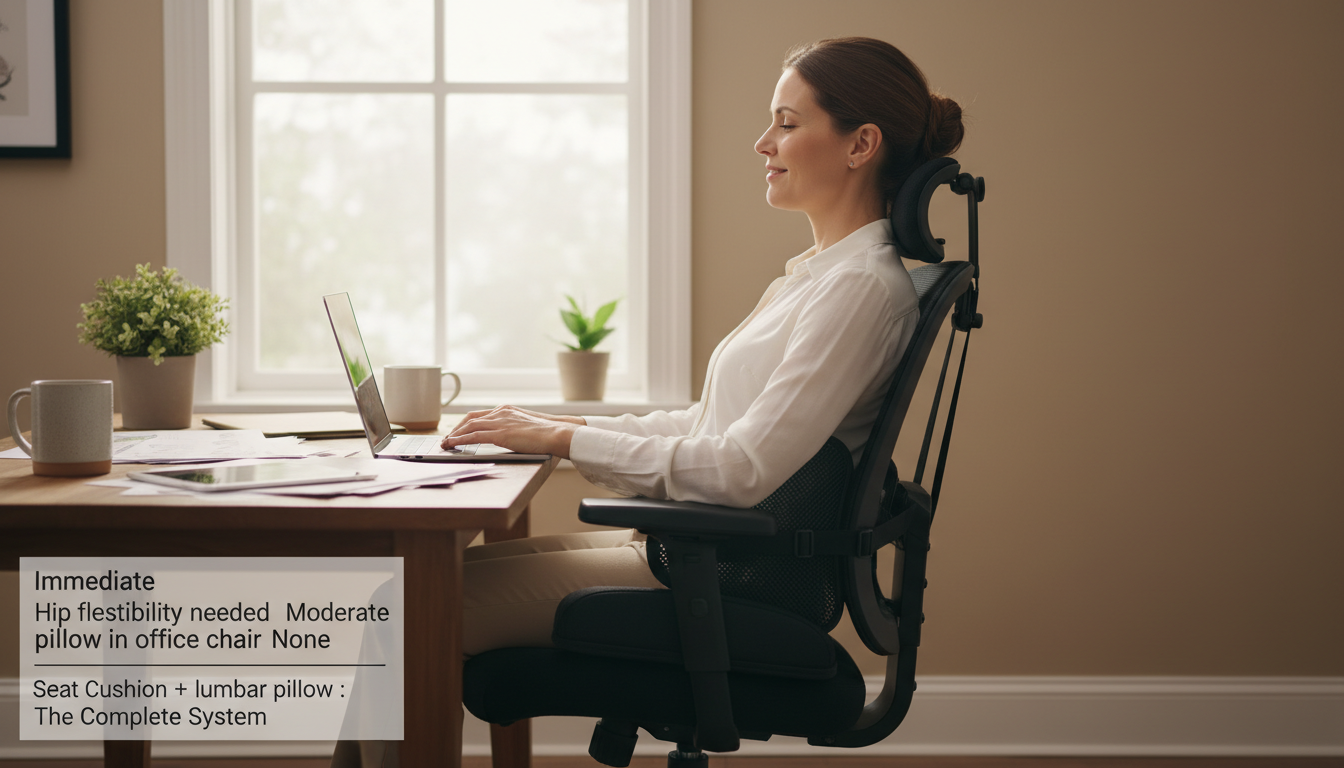
For comprehensive back pain relief, the most effective approach combines both:
A seat cushion establishes proper pelvic position—the foundation. A lumbar pillow maintains spinal curve—the structure. Together, they create optimal sitting alignment from base to mid-back.
Complete Your Ergonomic Setup
Pair your seat cushion with premium lumbar support for full-spine comfort. Memory foam that conforms to your unique curve.
Works With Any Seat Cushion | 30-Day Guarantee
Recommendation: Memory foam contoured cushion + lumbar pillow
General lower back pain typically benefits from better overall support and pressure distribution. The combination approach addresses both the seat surface and back support.
Recommendation: Coccyx cutout cushion (U-shaped)
Direct tailbone pain requires pressure relief in that specific area. The cutout design is essential—standard cushions may actually worsen coccyx pain by pressing on the sensitive area.
Recommendation: Coccyx cushion with thigh support channels
Sciatica involves nerve compression that can be aggravated by sitting position. Coccyx cutout reduces piriformis pressure, while thigh channels prevent nerve compression in the legs.
Recommendation: Contoured cushion with hip cutouts or soft edges
Hip pain during sitting often comes from pressure on the greater trochanter (side of hip). Look for cushions with lower density on the outer edges.
Recommendation: Wedge cushion to maintain anterior pelvic tilt
Sacroiliac joint pain often worsens with posterior pelvic tilt. A wedge cushion maintains the position that keeps SI joints in optimal alignment.
The softest cushion isn’t the best for back pain. Too-soft cushions allow your pelvis to sink and tilt backward—the exact problem you’re trying to solve. Look for supportive firmness that maintains position.
Standard cushions work for average body types. If you’re significantly above or below average height/weight, look for cushions sized appropriately. An undersized cushion won’t provide adequate support; oversized won’t fit your chair.
Adding a 2-3 inch cushion raises your seat height. Ensure your chair can lower enough to maintain proper desk ergonomics—feet flat, thighs parallel to floor, elbows at keyboard height.
Your body needs time to adapt to new positioning. Give any cushion at least one week before judging its effectiveness. Initial muscle soreness is common as your body adjusts to proper alignment.
Yes, seat cushions work in cars and can significantly improve driving comfort. Ensure the cushion has a non-slip bottom suitable for car upholstery. For cars, thinner cushions (1.5-2 inches) may be better to maintain proper pedal reach and visibility. Avoid cushions that slide on leather seats—look for rubber-grip bottoms.
For meaningful support, 2-3 inches is ideal for most office chairs. Thinner cushions (under 2 inches) don’t provide enough material for proper contouring and pressure distribution. Thicker cushions (over 3 inches) may raise you too high and create ergonomic problems with desk height.
Possibly. Lumbar support addresses your back, but if your pelvis is tilting incorrectly on a poor seat surface, lumbar support can only partially compensate. If you have good lumbar support but still experience lower back pain or discomfort, adding a seat cushion may solve the remaining issue.
Quality memory foam seat cushions last 2-4 years with daily use. Signs of replacement need include: visible compression that doesn’t recover, bottoming out when you sit, or reduced comfort compared to when new. Budget cushions may flatten within 6-12 months.
Memory foam provides better contouring and consistent support. Gel adds cooling but doesn’t conform as well. For most people, memory foam is superior for back pain relief. Consider gel-infused memory foam if you want cooling without sacrificing support quality. Pure gel cushions prioritize temperature regulation over ergonomic support.
Your glutes have forgotten how to work. It sounds strange,
Your hip flexors are the hidden culprits of desk-job back
Your back is stiff, tight, and angry. And you’ve got

That nagging pain at the base of your spine—right where
Sitting with a herniated disc can feel like torture. Every
Your desk chair is failing you. Even if you paid

That deep ache in your buttock that won’t quit? The

You’ve blamed your chair for years. And you’re probably right—but
Your back is aching right now, isn’t it? That dull
Is your lower back screaming at you by 3 PM?