

Gluteal Amnesia and Back Pain
Your glutes have forgotten how to work. It sounds strange,


You’ve invested in an ergonomic chair with built-in lumbar support, yet your lower back still aches. Before assuming you need a different chair entirely, consider this: built-in lumbar systems have fundamental limitations that a quality lumbar pillow can address. Understanding the differences helps you make the right choice for your back.
📋 Table of Contents
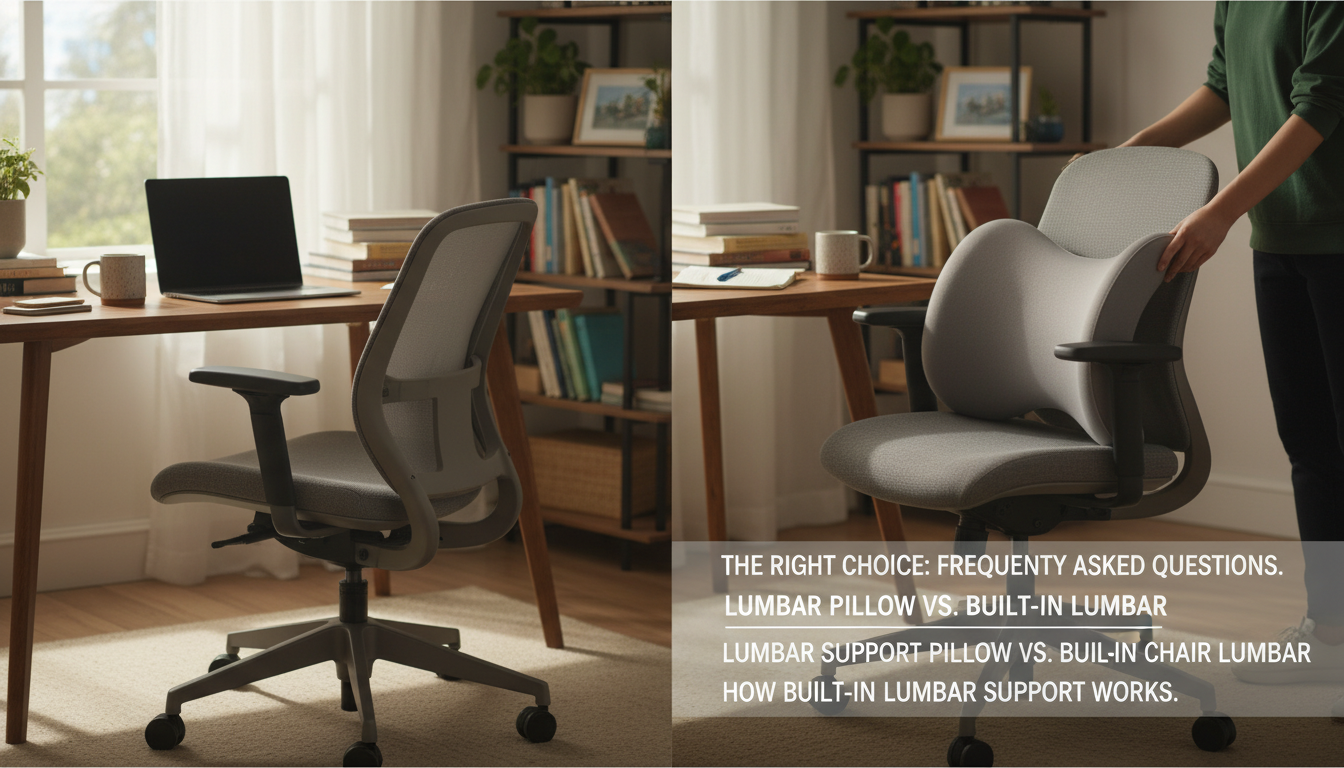
Built-in lumbar support systems fall into several categories, each with distinct mechanisms and limitations:
The most common type in budget and mid-range chairs. A curved section of the backrest provides static support at a predetermined location. You get what the designer decided was “average”—regardless of your actual anatomy.
Key limitations:
Mid-range to premium chairs often feature a lumbar pad that slides vertically. This addresses one major issue—positioning the support at the correct spinal level for your body.
Key limitations:
Premium chairs (typically $500+) offer both height and depth adjustment via knobs or pump systems. This provides the most customization among built-in options.
Key limitations:
A dedicated lumbar pillow operates on different principles than built-in support:
Memory foam lumbar pillows mold to your specific spinal curve rather than forcing your spine to match a generic shape. This conforming ability provides consistent support regardless of body type or position shifts.
Adjustable straps allow precise vertical positioning. You can move the pillow up, down, or tilt it to match your exact lumbar curve location—something even adjustable built-in systems can’t always achieve.
Your lumbar pillow moves with you. Same support in your office chair, car, airplane seat, or home couch. Built-in support stays with the chair.
| Feature | Built-In Lumbar | Lumbar Pillow |
|---|---|---|
| Height Adjustability | Fixed or limited range | Full range with strap positioning |
| Depth Range | 0.5-2 inches typical | 2-5 inches available |
| Conformability | Rigid or limited flex | Memory foam conforms to spine |
| Support Area | Narrow (4-6 inches) | Wide (10-14 inches) |
| Portability | Fixed to chair | Moves to any seat |
| Replaceability | May require chair replacement | Easy independent replacement |
| Cost | Included in chair price | $30-60 standalone |
Even expensive chairs with advanced lumbar systems often fail to provide adequate support. Here’s why:
Chair designers must create products for broad markets. Built-in support is positioned and sized for average body proportions. If you’re shorter, taller, or have different spinal curvature than average, built-in support often misses the mark.
Lumbar vertebrae (L1-L5) span approximately 4-5 inches vertically. Built-in support with limited adjustability might place pressure at L3 when your pain originates from inadequate L4-L5 support.
A pillow with adjustable positioning lets you target exactly where you need support.
Most built-in systems max out at 2 inches of depth. For people with pronounced lordosis (natural lumbar curve) or those who’ve lost curve due to prolonged poor posture, this isn’t enough to restore proper spinal alignment.
Built-in lumbar mechanisms typically protrude from a narrow area—often just a few inches wide. This creates pressure points rather than distributed support. A full-width pillow spreads support across the entire lower back.
Built-in systems use the same material as the rest of the chair—often mesh or firm foam. This doesn’t provide the conforming, pressure-distributing properties of dedicated memory foam designed specifically for lumbar support.
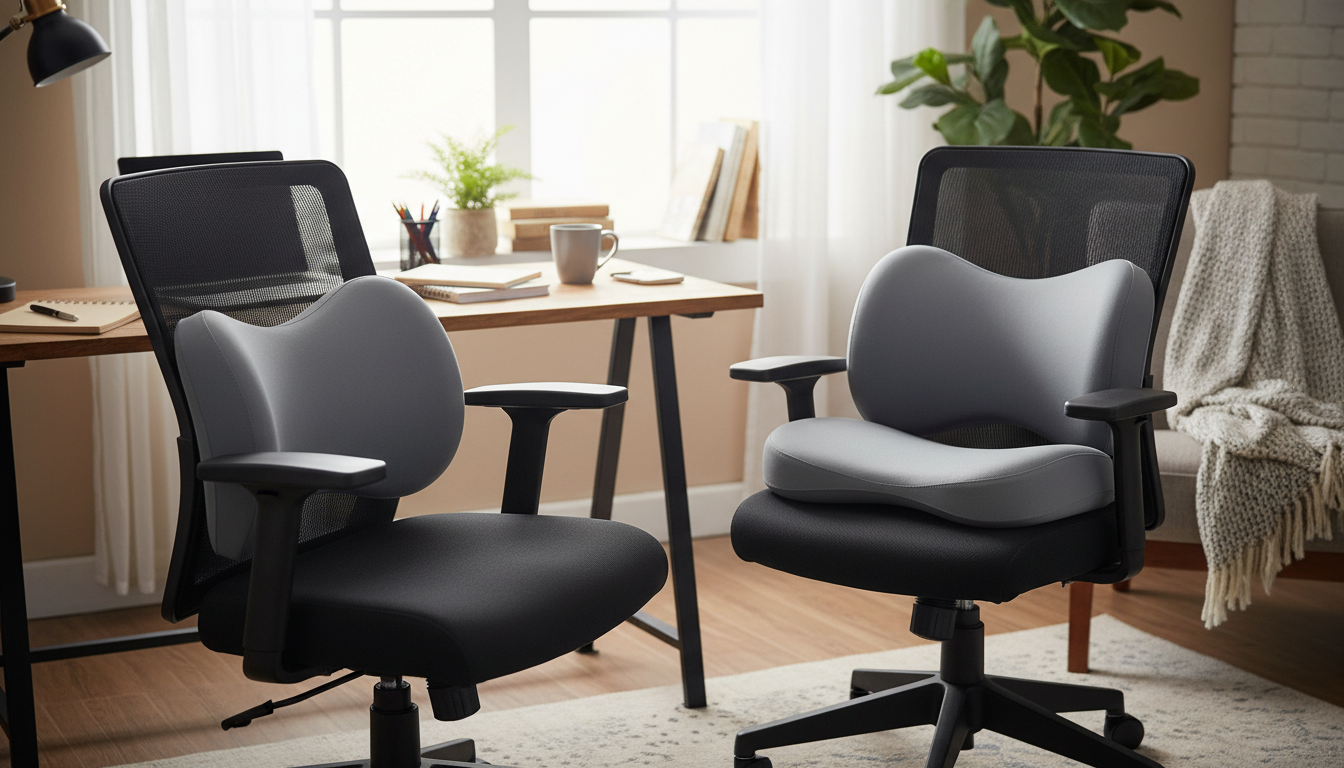
Here’s where many people go wrong: assuming it’s one or the other. Often, the best solution combines both.
If your chair has adjustable built-in support:
This approach gives you the conforming benefits of the pillow while the chair’s structure provides overall back support.
Upgrade Any Chair’s Lumbar Support
Premium memory foam pillow that conforms to your spine. Works with any chair—with or without built-in support.
Universal Strap System | 30-Day Guarantee | Free Shipping
Many people assume they need to upgrade their entire chair to get better lumbar support. Consider the math:
| Solution | Cost | Lumbar Customization |
|---|---|---|
| New ergonomic chair with adjustable lumbar | $300-800 | Moderate (still limited by design) |
| Premium ergonomic chair (Herman Miller, etc.) | $1,000-2,000 | Good (better range, still fixed width) |
| Quality memory foam lumbar pillow | $30-60 | Excellent (full positioning, conforming support) |
A $40 lumbar pillow often provides better customized support than upgrading to a $500 chair—and you keep your existing chair while gaining portable support for all other seating.
How do you know if your chair’s lumbar support is inadequate? Watch for these indicators:
The decision between built-in support, a lumbar pillow, or both depends on your specific situation:
For most people, a quality lumbar pillow—used alone or combined with built-in support set to minimum—provides superior comfort and support compared to relying on built-in systems alone.
No. Using an external accessory like a lumbar pillow doesn’t modify the chair in any way and won’t affect your warranty. The pillow simply sits between you and the backrest. Some manufacturers even recommend supplementary support if their built-in system doesn’t adequately fit your body.
Adjustability doesn’t guarantee adequacy. Most adjustable systems still have limited depth range, narrow support area, and rigid materials that create pressure points. A conforming memory foam pillow can provide superior support even when placed in front of an adjustable built-in system.
Yes, and it often works better than with solid-back chairs. The mesh allows the pillow to settle into a stable position, and you get the mesh’s breathability combined with the pillow’s conforming support. Use a pillow with a non-slip back surface for best results.
Not necessarily. Try a lumbar pillow first—it’s a fraction of the cost and often solves the problem entirely. The chair may still provide excellent overall support; the lumbar region is simply one area where external support can improve most chairs regardless of price.
Test by using a lumbar pillow for two weeks. If your lower back pain resolves but you still have other discomfort (shoulder pain, neck strain), the issue may be chair height, armrest position, or desk setup. If the pillow doesn’t help at all, consult a healthcare provider—the problem may not be the chair.
Your glutes have forgotten how to work. It sounds strange,

Your hip flexors are the hidden culprits of desk-job back
Your back is stiff, tight, and angry. And you’ve got

That nagging pain at the base of your spine—right where

Sitting with a herniated disc can feel like torture. Every
Your desk chair is failing you. Even if you paid

That deep ache in your buttock that won’t quit? The

You’ve blamed your chair for years. And you’re probably right—but

Your back is aching right now, isn’t it? That dull
Is your lower back screaming at you by 3 PM?