Your posture wasn't ruined in a day, and it won't be fixed in a day. Years of sitting, screen time, and modern lifestyle have trained your body into patterns...
Your posture wasn’t ruined in a day, and it won’t be fixed in a day. Years of sitting, screen time, and modern lifestyle have trained your body into patterns that feel normal but strain your spine. The good news: targeted exercises can retrain these patterns. The key is understanding which imbalances you have and addressing them systematically.
This guide covers exercises that correct the most common postural problems—forward head, rounded shoulders, and excessive lumbar curve—plus daily micro-corrections that make lasting change possible.
Understanding Postural Imbalances
Common Postural Patterns
Most postural problems follow predictable patterns:
Stand with heels, buttocks, and shoulders against wall
Note: Can back of head touch wall without straining?
Note: How much space between lower back and wall?
Note: Do shoulders touch easily or feel forced?
Ideal: Head touches naturally, hand slides behind lower back (but not more), shoulders touch without effort.
Why Exercises Alone Aren’t Enough
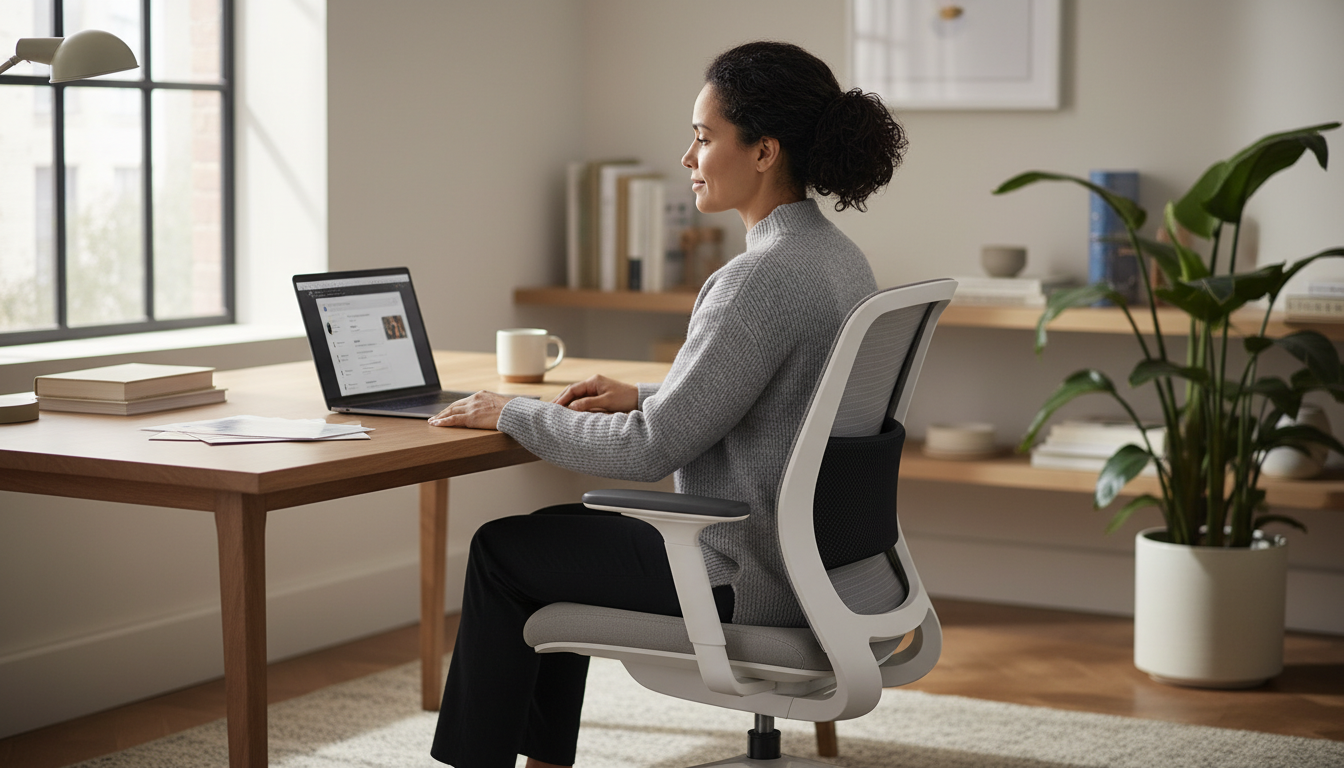
Posture exercises take 15-30 minutes daily. You spend 8-12 hours in positions that reinforce bad posture. Without changing your environment and habits—including proper lumbar support when sitting—exercises fight an uphill battle. Combine exercises with ergonomic support for lasting change.
Forward Head Correction
The Problem
For every inch your head moves forward, it adds about 10 pounds of strain on your neck and upper back muscles.
Exercises
Chin Tucks
The foundational exercise for forward head:
Sit or stand tall
Without tilting head up or down, draw chin straight back
Imagine making a “double chin”
Hold 5-10 seconds
Relax and repeat
Do: 10 repetitions, 5+ times daily
Tip: Can do at red lights, during TV commercials, at your desk.
Chin Tuck with Extension
Perform chin tuck
While holding tuck, tilt head back slightly
Feel stretch at base of skull
Hold 3-5 seconds
Do: 8-10 repetitions, 2-3 times daily
Prone Chin Tuck
Lie face down, forehead on rolled towel
Perform chin tuck (nod motion)
Lift head 1-2 inches off floor
Hold 5 seconds
Lower and relax
Do: 10 repetitions, once daily
Neck Flexor Strengthening
Lie on back, knees bent
Perform chin tuck
Lift head 1 inch off floor
Hold 5-10 seconds
Lower slowly
Do: 10 repetitions, once daily
Caution: Don’t hold breath or strain. If neck hurts, stop.
Exercises Fix Forward Head—Support Prevents It
Chin tucks strengthen your neck. Our lumbar pillow keeps your whole spine aligned so your head stays where it belongs.
Tight chest muscles and weak upper back muscles pull shoulders forward.
Stretches (Release the Tight)
Doorway Chest Stretch
Stand in doorway
Place forearm on door frame, elbow at shoulder height
Step forward through doorway
Feel stretch across chest
Hold 30-60 seconds each side
Do: 2-3 times daily
Corner Stretch
Face corner, forearms on each wall
Lean into corner
Feel stretch across both sides of chest
Hold 30-60 seconds
Do: 2-3 times daily
Upper Trap Stretch
Sit tall, hold chair with one hand
Tilt head away from held hand
Gently add pressure with opposite hand
Feel stretch along side of neck and shoulder
Hold 30 seconds each side
Do: Several times daily
Strengthening (Build the Weak)
Scapular Squeezes
Sit or stand tall
Squeeze shoulder blades together and down
Imagine putting shoulder blades in back pockets
Hold 5-10 seconds
Relax and repeat
Do: 15 repetitions, 3-5 times daily
Y-T-W Raises
Lie face down on floor or bench, arms hanging
Y: Raise arms forward at 45-degree angle, thumbs up
T: Raise arms out to sides, thumbs up
W: Elbows bent, squeeze shoulder blades, rotate hands up
Hold each position 5 seconds
Do: 10 of each, once daily
Rows
Use band, cable, or dumbbells
Pull weight toward lower ribs
Squeeze shoulder blades at end of motion
Control return
Do: 12-15 repetitions, 2-3 sets
Face Pulls
Use band or cable at face height
Pull toward face, elbows high and wide
Squeeze shoulder blades together
Control return
Do: 15-20 repetitions, 2-3 sets
Lower Back/Pelvic Correction
Anterior Pelvic Tilt (Excessive Curve)
Hip Flexor Stretch (Crucial)
Kneel on one knee, other foot forward
Tuck pelvis under (posterior tilt)
Shift weight forward
Feel stretch in front of back hip
Hold 60-90 seconds each side
Do: 2-3 times daily
Dead Bug
Lie on back, knees bent 90 degrees, arms up
Press lower back into floor
Lower opposite arm and leg toward floor
Only go as far as back stays flat
Return and repeat other side
Do: 10 each side, 2 sets
Glute Bridge with Posterior Tilt
Lie on back, knees bent
Tuck pelvis (flatten back to floor)
Maintain tuck as you lift hips
Squeeze glutes at top
Lower with control
Do: 15 repetitions, 2 sets
Bird Dog
Start on hands and knees
Maintain neutral spine throughout
Extend opposite arm and leg
Don’t let lower back arch
Hold 5 seconds, return, alternate
Do: 10 each side, 2 sets
Swayback Correction
Swayback requires different exercises:
Hip Flexor Strengthening
Lie on back, one knee to chest
Press lower back flat
Slowly lower leg toward floor
Only go as low as back stays flat
Return to start
Do: 10 each side
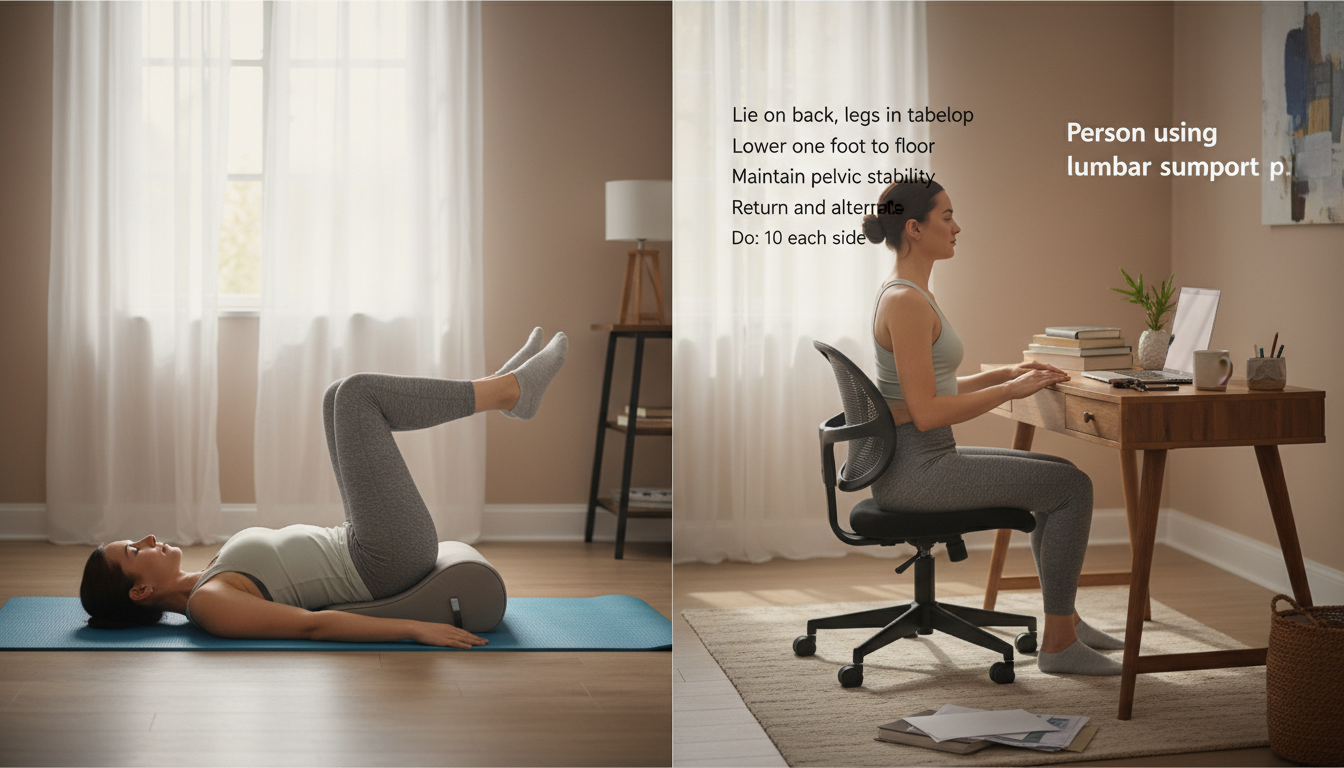
Lower Abdominal Work
Lie on back, legs in tabletop
Lower one foot to floor
Maintain pelvic stability
Return and alternate
Do: 10 each side
Person using lumbar support pillow in office chair
Daily Micro-Corrections
The Power of Frequent Small Corrections
Better than one 30-minute session: dozens of brief corrections throughout the day.
Hourly Check-In Protocol
Every hour, take 30 seconds:
Chin tuck (5 seconds)
Shoulder roll back and down (5 seconds)
Squeeze shoulder blades (5 seconds)
Check sitting posture, adjust lumbar support
Posture Triggers
Attach corrections to existing habits:
Every red light: Chin tuck
Every time you check phone: Bring phone up, don’t look down
Every email: Check shoulder position
Every bathroom break: Wall angels (2 reps)
Before sitting down: Adjust lumbar support
Wall Angels
Quick posture reset:
Stand with back against wall
Heels 4 inches from wall
Press lower back, shoulder blades, head to wall
Arms at sides, raise to 90-degree position (goalpost)
Slide arms up and down wall
Do: 10 repetitions
Use for: Morning wake-up, mid-day reset, evening recovery
Comprehensive Daily Program
Morning Routine (10 minutes)
Exercise
Duration/Reps
Target
Cat-cow
10 cycles
Warm up
Chin tucks
10 reps
Forward head
Wall angels
10 reps
Shoulders
Hip flexor stretch
60 sec each
Pelvis
Bird dog
8 each side
Core/back
Throughout Day
Hourly check-in protocol (30 seconds each)
Posture triggers as they occur
Adjust lumbar support when sitting
Evening Routine (10-15 minutes)
Exercise
Duration/Reps
Target
Doorway chest stretch
60 sec each
Chest release
Y-T-W raises
10 each
Upper back
Hip flexor stretch
90 sec each
Pelvis
Glute bridge
15 reps
Glute activation
Dead bug
10 each side
Core stability
Frequently Asked Questions
How long does it take to correct bad posture?
Expect 2-4 weeks to notice changes, 2-3 months for significant improvement, and 6+ months for lasting change. Posture developed over years; it won’t change overnight. Consistency matters more than intensity. Daily micro-corrections plus dedicated exercises, combined with ergonomic support during sitting, produce the fastest results.
Can posture really be permanently fixed?
Yes, but “fixed” requires ongoing maintenance. You can retrain your muscles and movement patterns, but without continued practice and good habits, old patterns return. Think of it like fitness—you can get in shape, but you have to maintain it. Good ergonomic support reduces the effort required for maintenance.
Should I focus on stretching or strengthening?
Both are necessary. Tight muscles (chest, hip flexors, upper traps) pull you out of alignment—they need stretching. Weak muscles (lower traps, deep neck flexors, glutes) can’t hold proper position—they need strengthening. Most people need to stretch the front of their body and strengthen the back. Address both for complete correction.
Why does good posture feel uncomfortable at first?
Your body has adapted to poor posture—it feels “normal” because you’re used to it. Good posture uses different muscles that have become weak and changes positions that have become tight. Initial discomfort is normal; it indicates you’re working on the right things. As muscles adapt, proper posture becomes more comfortable than poor posture.
Can I fix posture with exercise alone, or do I need support products?
Exercise is essential, but you spend far more time sitting than exercising. Without proper support during sitting hours, you’re fighting an uphill battle—exercise improves posture, then sitting undoes it. Combining exercises with good lumbar support (and other ergonomic tools) produces much faster and more lasting results than either approach alone.
The Bottom Line
Posture correction requires a multi-faceted approach:
Identify your pattern: Forward head, rounded shoulders, pelvic tilt, or combination
Stretch the tight: Release muscles pulling you out of alignment
Strengthen the weak: Build muscles that hold proper position
Correct constantly: Micro-corrections throughout the day
Support always: Proper lumbar support protects your progress
Posture wasn’t ruined in a day, and it won’t be fixed in a day. But with consistent effort and the right support, lasting improvement is absolutely achievable.
Exercises Build Posture—Support Maintains It
You can’t exercise 8 hours a day. Our lumbar pillow works while you sit, protecting the posture improvements your exercises create.